
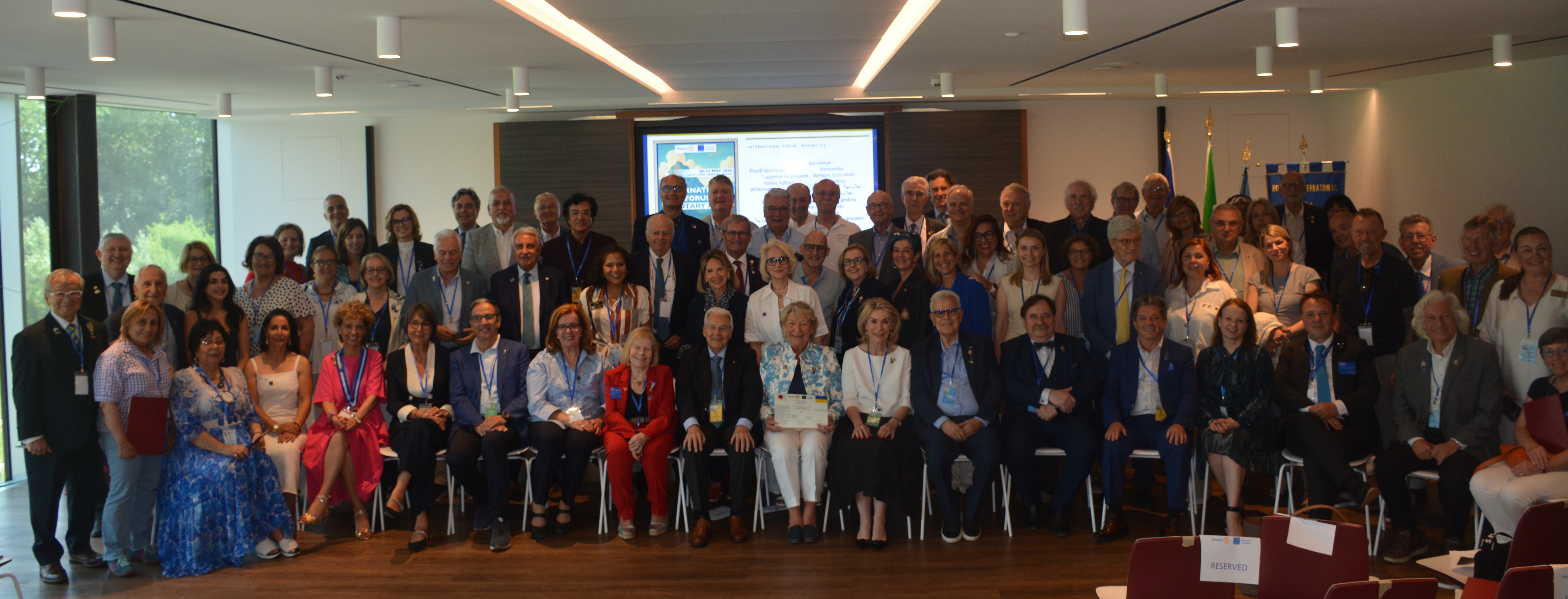
The International Rotary Inter-Country Committees (ICC) Forum took place from May 28 to 31, 2026, in Italy, spanning the northern cities of Bergamo, Como, Lecco and Milano.
This international event served as a major platform for cross-border diplomacy, strategic environmental action plans, and a historic leadership transition. The event convened Rotarians and international delegates to address a foundational pillar of the Rotary experience: advancing peace through cross-cultural understanding, structured dialogue, mediation, and international cooperation. Bringing together hundreds of Rotarians from over thirty countries, the forum culminated in the ICC World Peace Forum on Saturday, May 30, 2026.
Nathalie Huyghebaert the Outgoing President ICC, 2024– 2026, brought her two-year mandate to a successful conclusion at the Bergamo event. Her leadership emphasized decentralized, non-bureaucratic, and highly active multicultural networks. She underlined that the efficacy of the ICCs relies on strategic succession planning, shared accountability, and leadership models that leave a permanent operational blueprint for future administrations.
Annemarie Mostert the Incoming President ICC, 2026–2028, introduced a strategic focus on expanding ICC operations across fragmented global borders, aiming to transition the organization from reactive crisis response to a structured, proactive institution of citizen diplomacy. The goal for 2026–2028 is to build a structured, proactive framework of citizen diplomacy. This strategy emphasizes installing institutional dialogues and permanent cross-border agreements in areas vulnerable to social and political fragmentation.
The key initiatives under the new leadership will include expanding peace corridors in Southern Africa and Eastern Europe, as well as fostering environmental peacebuilding through partnerships like EndPlasticSoup. Recognizing that environmental degradation is a primary driver of modern resource conflict, the ICC Executive Council signed a formal Cooperation Action Plan (2026–2028) with the global EndPlasticSoup movement. This strategic initiative commits ICCs worldwide to tangible interventions aimed at eliminating microplastics and plastic pollution from global waterways, charting a green path forward for international service
Finally, in a great vote of confidence, the General Assembly elected Alessandro Pastorini the ICC National Chair for Italy, Malta, and San Marino, as the Presidentof ICC Executive Council for the 2028–2030 biennium, ensuring that his visionary regional model will soon guide the entire international network.
Frontline Perspectives & Intergenerational Leadership
The forum transitioned to operational realities with a presentation by Monica Napoli, journalist and Sky TG24 correspondent. Reporting on the frontiers of the Mediterranean and European borders, Napoli brought a data-driven yet deeply humanized journalistic lens to geopolitical crises. She underscored that reporting on conflict and migration is vital to preventing international indifference, noting that accurate journalism prevents human tragedies from being reduced to mere statistics.
An intergenerational panel titled “Rotaract/Rotary/ICCs – Together for Peace,” moderated via Zoom by Emil Moawad, introduced the strategic vision of emerging leaders Ezgi Batu, Laura Sasse, and Elise Nassim. This session highlighted the necessity of integrating the Rotaract network into Rotary structures. The panelists demonstrated that long-term peace strategies require the innovation, technological adaptability, and moral clarity of the next generation to remain viable.
Philosophical Foundations & Practical Mediation
The cultural and academic highlight featured a keynote lecture by philosopher Professor Donatella Di Cesare, entitled “The Responsibility of Peace. A Common Commitment.” Professor Di Cesare deconstructed sentimental definitions of peace, reframing it as a rigorous ethical and political responsibility. She argued that peace is far more than the temporary absence of military conflict; it is an active, demanding policy of human recognition that requires societies to systematically reject the normalization of violence.
Richard Knowlton, Member of the national ICC Coordination Committee for Italy, San Marino and Malta, and Professor Giorgio Del Zanna, of the Community of Sant’Egidio, held a discussion on the theme “Mediation begins with us”. Professor del Zanna brought to the Forum the experience of a community that for decades has been active in processes of dialogue, reconciliation and international mediation. The message that emerged in the discussion was powerful: mediation is not only a diplomatic technique, but an inner posture. It begins in the way we listen, in the words we choose, in the daily conflicts we decide not to fuel, and in the willingness to create spaces where only walls seem to exist. Peace, before becoming a treaty, must become a style.
Civil Diplomacy in Fragmented Geopolitics
The final panel session, “Peace in a Fragmented World: The Strategic Role of Civil Diplomacy and Global Networks,” was introduced by DGN Michel Davoudian. A distinguished panel featuring Mazin Qumsiyeh, Shab Elawar, Peace Fellow Elise Nassim, and Ambassador Daniele Verga analyzed the limits of traditional state-level negotiations in a fractured global landscape. The consensus reached highlighted that modern conflict resolution requires robust civil diplomacy networks—encompassing academic institutions, NGOs, local communities, and international bodies like the ICCs—to effectively build trust where formal diplomacy stalemates.
Recognition & Organizational Excellence
The forum concluded with two high-profile awards ceremonies emphasizing organizational merit and the power of exemplary leadership:
-The ICC Peace Prize: Managed by Giuseppe Mosci (ICC Secretary) alongside PDG Annemarie Mouchet and Nathalie Huyghebaert, this ceremony formally recognized individuals whose strategic initiatives have delivered measurable peace outcomes, reinforcing the organizational value of visible role models.
-The ICC Special Awards: Led by Michel Davoudian, this session extended formal institutional gratitude to key contributors whose work ensures the vitality of the Inter-Country Committees. Within an international body, these recognitions serve a vital corporate function: preserving institutional memory, validating high-impact service, and strengthening global organizational alignment.
Stepping into the role of President of ICC Executive Council for the 2026–2028 biennium, Annemarie Mostert brings a sophisticated corporate and humanitarian perspective. Her leadership centers on fostering "Positive Peace." She defines this not merely as the absence of war, but as an active, respectful partnership built across cultures and borders. Her mandate is clear: transition the ICC from a reactive network into an indispensable, institutionalized pillar of Rotary’s global peace architecture.