
More than 1,000 students in the Zhansugurov rural district of Kazakhstan will now have access to modern interactive learning tools every year — because the new equipment arrived, but because teachers were trained to use it with confidence.
In August 2026, Rotary Club Almaty and Rotary Jeju Noble from the Republic of Korea joined local partners to launch the project “Interactive Equipment for Remote Rural Areas of Kazakhstan.” The project provided 12 interactive boards to four schools in the Zhansugurov rural district and included a three-day practical training programme for 25 teachers.
The partnership was formally strengthened on 17 August 2026 at InterContinental Almaty, where members of Rotary Club Almaty, the delegation of Rotary Jeju Noble and Ilyas Musabalanov, Akim of the Zhansugurov rural district, signed a memorandum of cooperation.
For Rotary Club Almaty and Rotary Jeju Noble, this is already the second joint project. After previous cooperation in the field of health and social support, the new initiative moves their partnership into education and human capital development.
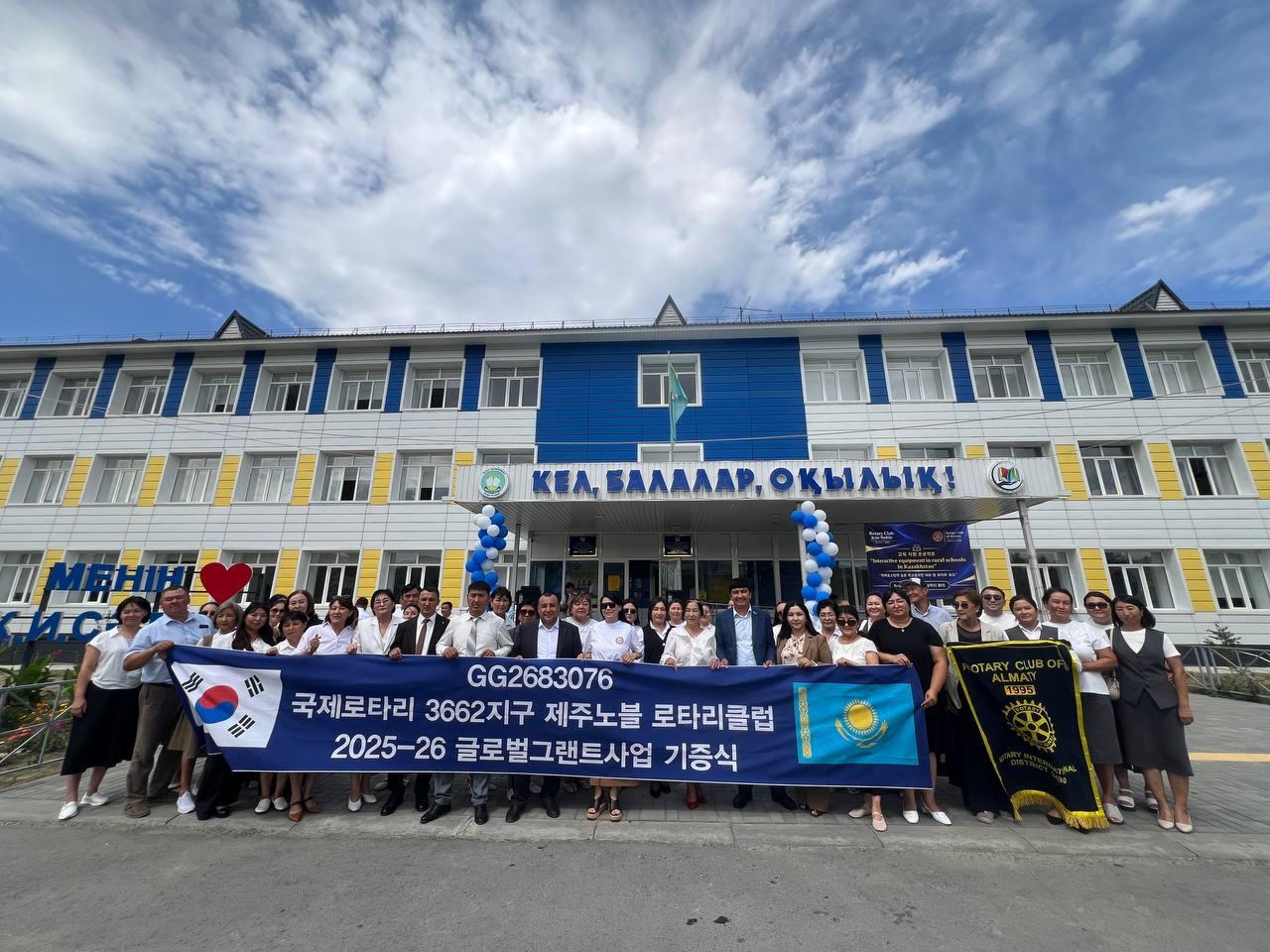
On 20 August, the equipment was officially handed over to four schools in Zhansugurov. The ceremony brought together local authorities, school directors, teachers, parents, representatives of Rotary Club Almaty and Rotary Jeju Noble, and media representatives.
The project was designed with a clear understanding: technology alone is not enough. That is why the donation of interactive boards was accompanied by 24 hours of teacher training, delivered over three days by certified specialists from the Centre of Pedagogical Excellence. The training focused on the practical use of interactive tools, integration of the boards into lessons and methods for engaging students more actively in the learning process.
The joint project was led by Gaukhara Batalova, who coordinated cooperation with the Korean partners, local authorities and schools, and helped guide the initiative from the first discussions to implementation in Zhansugurov. She emphasised that the goal was not simply to donate equipment, but to create a resource that would support teachers and students for years.
Dong-Wang Ko, President of Rotary Jeju Noble, underlined the value of international cooperation that leads to concrete change in people’s lives. He described education as an investment with long-term effect and expressed appreciation for the continuation of partnership with Rotary Club Almaty in Kazakhstan.
For Rotary Club Almaty, the project also reflects a wider strategic direction for the 2026–2027 Rotary year. Under the leadership of President Dilyara Mazhitova, the club is focusing on measurable impact, stronger partnerships, transparent philanthropy and long-term project development.
The Zhansugurov project shows what can happen when international friendship, local leadership and professional expertise come together. Four schools received modern tools. Twenty-five teachers gained new skills. More than 1,000 students each year will benefit from a more interactive learning environment.
This is how Rotary creates lasting impact — by investing not only in equipment, but in the people who turn that equipment into opportunity.